


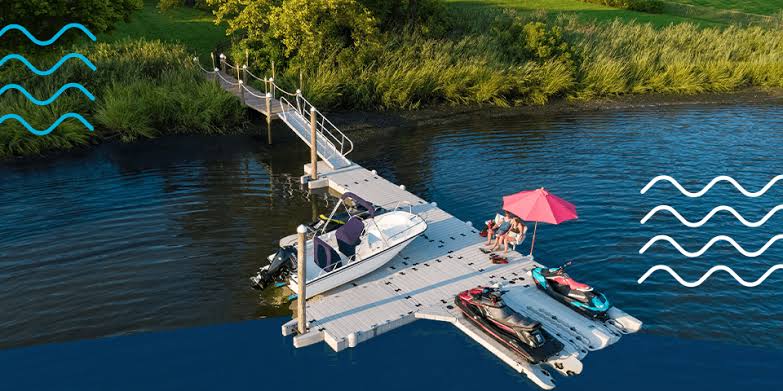


A floating dock isn’t automatically the right answer for every shoreline, but certain site conditions make it especially practical. Water depth, seasonal fluctuations, shoreline slope, installation access, and future expansion all affect the decision. A boat dock builder may recommend a floating system when the property needs more flexibility than a traditional fixed layout can comfortably provide.
Defining the Core Differences Between Fixed Layouts and Modular Sections
Fixed docks rely on posts, pilings, or other supports that hold the walking surface at a set elevation. Floating systems ride on buoyant components and move with the water.
Many floating docks are also built in connected sections. That gives owners more flexibility with layout and makes it easier to add or rearrange sections later. On properties where shoreline conditions may change, modular construction can be useful because the system does not have to remain locked into one permanent footprint.
How Water Depth and Fluctuations Dictate Your Structural Design Choice
Deep water is one of the clearest reasons a builder may suggest an aluminum floating dock. Extending fixed supports to the bottom can become more complicated as depth increases, especially where the shoreline drops off sharply.
Changing water levels matter just as much. A fixed dock stays at one elevation while the water moves around it. A floating system rises and falls with the surface, which can keep boarding height more consistent through seasonal changes.
Floating dock builders still have to account for anchoring, gangway angle, and the full range of expected movement.
The Physics of Load Distribution: Fixed Integrity vs. Modular Flexibility
Fixed docks transfer loads into their supports and foundations. Floating systems distribute weight through the frame and flotation beneath it.
That means float placement is important. People, seating, boat access, storage, and other equipment can shift weight across the dock. A well-designed floating system spreads those loads so one section does not sit noticeably lower than another.
Connections between modules also need controlled movement. They should allow sections to respond to waves without becoming loose or placing excessive force on adjoining frames.
Installation and Off-Season Storage Timelines for Both Systems
Site access can push a project toward a floating design. Steep banks, deep water, or limited equipment access may make bottom-supported construction harder to complete.
Modular floating sections may be assembled near shore and positioned in stages. In areas where ice makes seasonal removal necessary, individual sections can sometimes be disconnected and stored more easily than one large permanent structure.
That doesn’t mean every floating dock should be removed each winter. The right approach depends on local ice movement, water conditions, anchoring, and the system itself.
Adapting to Future Needs: The Long-Term Scalability of Modular Aluminum Units
A waterfront rarely stays exactly the same. Owners may buy a larger boat, add another slip, create more swimming space, or want a wider gathering area later.
This is where modular aluminum docks can be attractive. If the frame and connection system are designed for expansion, additional sections may be incorporated without replacing the original dock.
A builder should still review flotation and anchoring before expansion. More dock area changes weight distribution, wind exposure, and the loads placed on connection points.
Cost Efficiency Analysis: Initial Purchase Price vs. Future Modification Expenses
A floating dock may cost more than a basic fixed setup in some situations, especially once flotation, hinges, gangways, and anchoring are included. The comparison changes when future modifications enter the picture.
A fixed dock that later needs substantial changes may require new supports or significant reconstruction. A modular floating system can sometimes accommodate a different layout with less structural work.
Owners comparing aluminum boat docks for sale should also consider maintenance and seasonal handling. The lowest initial price does not always translate into the lowest long-term ownership cost.
A professional recommendation usually comes down to the behavior of the water and the way the property will be used. Flotation Systems Inc. can help owners explore that decision through all-aluminum residential and commercial dock systems, including floating configurations, anchoring solutions, aluminum decking, ramps, gangways, and custom layouts. Those options give buyers a practical way to compare a floating setup with more permanent alternatives before settling on a design.


