


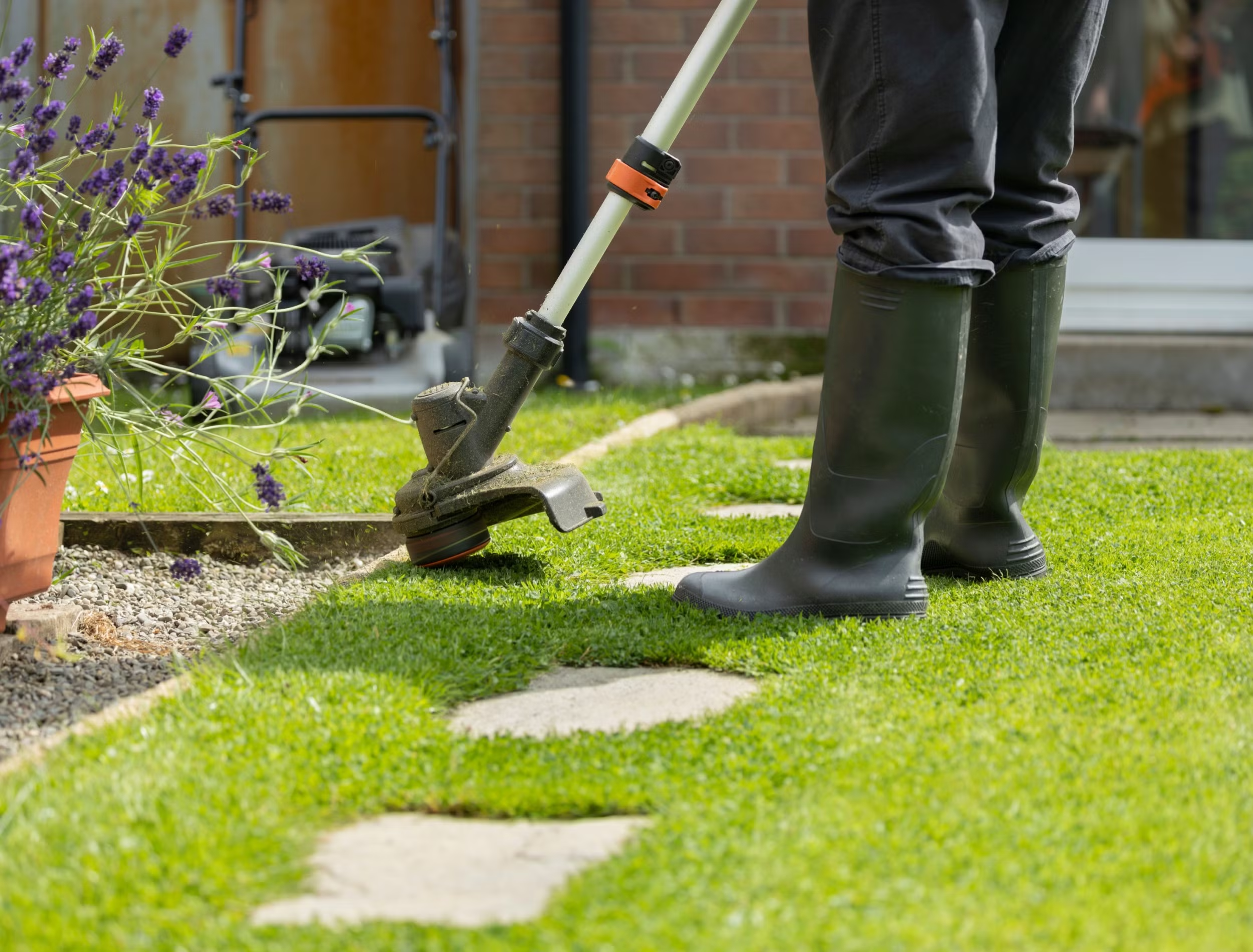


For many Canadian homeowners, the joy of gardening is found in the details—the curve of a stone-edged flowerbed, the sharp contrast between a vibrant perennial garden and a deep green lawn, and the neatly defined borders of a suburban lot. However, achieving that “professional look” often comes at a high cost of time and physical labor. Traditional lawn care usually involves two steps: mowing the main area and then spending an additional hour or more with a heavy, vibrating string trimmer to fix the edges.
In Canada, where landscaping often features complex, multi-layered garden beds and varied edging materials (from timber to river rock), the “edge problem” is particularly acute. Standard mowers—and even most first-generation robotic mowers—leave a significant “halo” of uncut grass around obstacles. To truly reclaim your weekend, you need a solution that integrates precision cutting with intelligent navigation. This guide explores how to minimize manual trimming and why UltraTrim technology is a game-changer for Canadian gardens.
The “Edge Gap” Challenge in Canadian Landscaping
The layout of a typical Canadian yard in provinces like Ontario, BC, or Alberta often includes distinct zones: a patio for summer BBQs, decorative mulch beds for moisture retention, and fenced perimeters. Standard mowers have a cutting deck centered between the wheels, creating a physical limitation: they cannot cut grass that is directly adjacent to a vertical surface like a fence or a raised garden bed.
This leaves homeowners with a “fringe” of long grass that:
- Harbors Pests: Long grass near garden beds can become a breeding ground for ticks and mosquitoes, common concerns for Canadian families.
- Invades Flowerbeds: Without a clean cut, aggressive grass species like Kentucky Bluegrass will quickly creep into your mulch and choke out your flowers.
- Ruins Curb Appeal: No matter how short the rest of the lawn is, shaggy edges make a property look neglected.
Enter UltraTrim: Engineering for the Borders
To solve this, MOVA has developed a specialized hardware and software integration known as UltraTrim Technology. Instead of a fixed, centered blade, mowers equipped with this technology utilize an offset cutting disc and advanced positioning sensors to get closer to the perimeter than ever before.
When searching for a robotic lawn mower in Canada, the ability to handle edges is often the deciding factor between a tool that “helps” and a tool that “replaces” manual labor. MOVA’s system allows the mower to cut within 2 inches (5 cm) of walls and garden borders, effectively reducing the need for manual string trimming by up to 90%.
Recommended Product: MOVA LiDAX Ultra 1000
For homeowners focused on precision and clean lines, the MOVA LiDAX Ultra 1000 is the ideal choice. While it is compact and efficient, it carries the same high-end navigation and edging tech as its larger counterparts.
Why the Ultra 1000 Excels at Edging:
- 3D LiDAR Navigation: Precision edging requires the mower to know exactly where the lawn ends and the garden begins. 3D LiDAR scans the environment in real-time, allowing the mower to follow the exact contour of a curved flowerbed without accidentally dipping into the mulch.
- RTK-Free Boundary Management: Traditional mowers require you to bury a wire exactly where you want the mower to stop. If you miscalculate by an inch, the edge is ruined. With MOVA’s wireless setup, you can fine-tune the virtual boundary via the app to ensure the mower gets as close as possible to your patio or fence.
- Offset Blade Design: The cutting disc is strategically positioned to reach beyond the wheel line, allowing the blades to sweep over the edge of the turf.
| Feature | Standard Robotic Mower | MOVA UltraTrim System
|
|---|---|---|
| Cutting Distance from Edge | 5 – 8 inches (12-20 cm) | Under 2 inches (5 cm) |
| Manual Trimming Frequency | Every 1-2 weeks | Once a month (or less) |
| Curved Border Navigation | Rough “stair-step” movements | Smooth, continuous path following |
Tips for Designing a “Mower-Friendly” Canadian Garden
To maximize the efficiency of your MOVA LiDAX Ultra 2000 or Ultra 1000, consider these minor landscaping adjustments:
- Level Edging: If your garden bed is flush with the lawn (using metal or plastic edging), the mower can actually overlap the edge slightly, leaving zero uncut grass.
- Mulch Buffer: A 2-inch strip of mulch or gravel between your grass and a high wall allows the mower’s blades to cover every inch of turf without the chassis hitting the wall.
- Smooth Curves: While MOVA’s AI can handle tight corners, designing garden beds with sweeping curves allows the mower to maintain its speed and efficiency, resulting in a more uniform cut.
The Result: A Professional Finish Without the Effort
In the past, owning a robotic mower meant accepting a “mostly finished” lawn. You would still need to pull out the weed whacker every weekend to clean up the borders. With the advent of UltraTrim and 3D LiDAR navigation, that compromise is a thing of the past.
For the Canadian homeowner who values precision, the MOVA smart home ecosystem provides the tools necessary to maintain a golf-course-quality edge with zero manual effort. By focusing on the details of the edge, MOVA ensures that your lawn isn’t just “mowed”—it’s professionally manicured.
Conclusion
Don’t let the edges of your garden define how you spend your summer. Embrace the precision of AI-driven trimming and enjoy a seamless transition from your lush Canadian lawn to your beautiful garden beds. The era of manual trimming is coming to an end; it’s time to let technology take the lead.


