


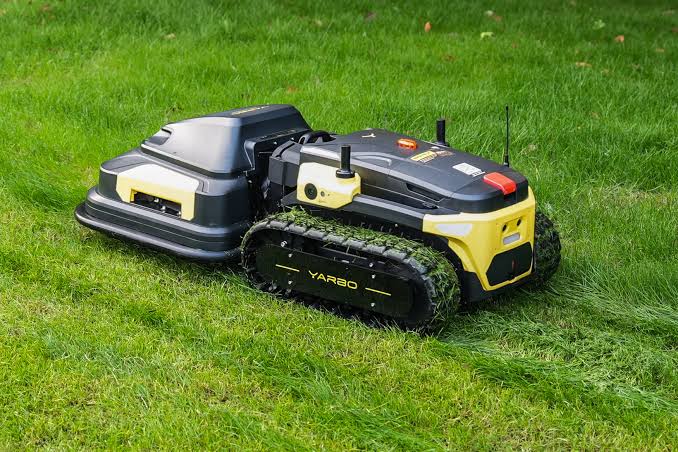


Managing a residential lawn in suburban neighborhoods across the United States often presents a structural challenge: properties are divided into distinct front and back yards. Separated by side gates, paved walkways, fencing, or varying ground elevations, these split landscapes have historically made automated mowing difficult. Traditional robotic mowers frequently struggled with separated lawns, getting stuck along narrow paths or requiring tedious manual repositioning between isolated zones.
Modern advancements in automated turf maintenance have introduced multi zone robotic technology. Designed specifically for properties up to 0.5 acre, multi zone robot lawn mowers allow homeowners to maintain disconnected grass zones seamlessly. Understanding how multi zone mapping functions, how mowers handle structural boundaries, and how navigation systems overcome obstacles provides a clear blueprint for effortless lawn maintenance.
The Structural Challenge of Split Residential Lawns
For decades, robotic lawn mowers relied on physical perimeter wires buried around the edge of the property. While boundary wire setups were manageable for a single unified plot of grass, they became complex, costly, and prone to breakage when applied to multi-zone layouts. Homeowners with separate front and back yards faced continuous operational issues:
- Physical Isolation: Backyards enclosed by wooden privacy fences or gated side yards isolated the mower, preventing automatic travel to the front yard.
- Varied Grass Conditions: Front yards often receive different sunlight exposure, foot traffic, and watering schedules compared to backyards, demanding tailored mowing heights and frequencies.
- Terrain Disparities: Front lawns may feature ornamental slopes or flowerbeds, whereas backyards often contain children’s toys, outdoor furniture, and steeper inclines.
To address these challenges, advanced mowers utilize multi-map technology and wire-free navigation, establishing distinct virtual management zones for each area of the yard.
How Multi Zone Management Functions
At the core of multi zone robotic mowing is digital spatial mapping. Instead of relying on physical boundary lines, the mower scans the environment using onboard sensors to create a high-precision three-dimensional map of the property. Through a companion smartphone application, users can create independent mowing zones, set custom virtual boundaries, and define narrow pass-through corridors.
Key Technical Advantages of Multi Zone Systems:
By operating on dual-map or multi-zone support systems, a single robotic unit can store independent profiles for up to 150 zones on complex landscapes. Homeowners can define individual cutting schedules, adjust blade heights for distinct turf varieties, and establish permanent no-go zones around gardens or pools.
For properties where the front and back yards are connected by a paved walkway or narrow side gate, the mower uses intelligent passage navigation to transition between zones automatically. In scenarios where a physical barrier like a locked gate prevents autonomous travel, dual-map management allows the user to place the unit in the secondary zone, where it executes its dedicated mowing cycle before returning to standby.
Overcoming Signal Interference: LiDAR vs. Satellite Navigation
A critical factor in multi zone lawn care is navigation reliability. Earlier generations of wire-free mowers relied heavily on satellite-based navigation, such as Real-Time Kinematic (RTK) positioning. While RTK systems function well in open fields, residential yards present common signal obstacles:
- Overhanging tree canopies and mature foliage blocking satellite line-of-sight.
- Multi-story residential houses and tall garage structures causing multipath signal interference.
- Tall perimeter fencing dampening signal reception along yard edges.
To eliminate reliance on external RTK base stations or satellite signals, cutting-edge mowers utilize RTK-Free 3D LiDAR navigation. By emitting laser pulses to measure distance and map surrounding surroundings in real time, LiDAR systems maintain millimeter-level accuracy regardless of tree cover, tall structures, or lighting conditions. This guarantees uninterrupted mowing under dense tree lines and close to house foundations.
Slopes and Obstacles: Matching Mowers to Terrain Complexity
Front and back yards rarely feature identical terrain. Front yards may feature gentle decorative mounds, while backyards often include sharp embankments or uneven drainage channels. Selecting the right propulsion system ensures consistent cutting performance across all zones.
| Lawn Feature / Challenge | Standard Terrain Requirements | Complex & Extreme Terrain Requirements |
| Maximum Incline Capability | Up to 45% slope (approx. 24 degrees) | Up to 80% slope (approx. 38 degrees) |
| Drive System | Rear-Wheel Drive (RWD) with off-road tread | All-Wheel Drive (AWD) with dual drive motors |
| Passage Width Navigation | Navigates narrow pathways down to 23.6 inches | Navigates narrow pathways and rough ground easily |
| Cutting System Efficiency | Single disc precision cutting system | Dual-disc cutting deck (up to 15.8 inches wide) |
Standard residential slopes up to 45% are easily managed by models like the MOVA LIDAX Ultra 2000, which utilizes efficient U-shaped path routing and high-traction off-road wheels. For lawns characterized by extreme hills, wet inclines, or heavily corrugated ground, all-wheel-drive units like the MOVA LIDAX Ultra 2000 AWD offer the traction required to prevent wheel slippage and turf damage.
AI Obstacle Avoidance for Busy Family Lawns
A major concern for homeowners adopting robotic lawn care is safety and obstacle management. Backyards in particular are dynamic environments where garden furniture, hose reels, children’s toys, and pets are frequently present.
Modern mowers incorporate AI-powered visual recognition systems trained to identify and navigate around more than 300 common yard objects. Combining 3D LiDAR spatial awareness with AI vision technology, the mower continuously scans the path ahead. When an object is detected—whether a forgotten toy on the lawn or a low-hanging garden ornament—the system dynamically recalculates its route in real time without stopping or requiring manual intervention.
Optimizing Lawn Maintenance across 0.5-Acre Properties
For medium-sized yards up to 0.5 acre, efficient cutting capacity is essential to keep grass healthy. Fine, frequent cuts foster dense lawn growth by leaving tiny grass clippings behind to serve as natural fertilizer. Advanced multi zone units leverage high-output 36V battery platforms and wide cutting decks to cover extensive square footage efficiently, reducing total operation time and ensuring the lawn remains pristine every day of the week.
By combining intelligent multi-zone mapping, robust slope capabilities, and reliable RTK-free navigation, multi zone robotic mowers deliver a complete hands-off solution for modern residential properties, bridging the gap between front yard presentation and backyard functionality.


