
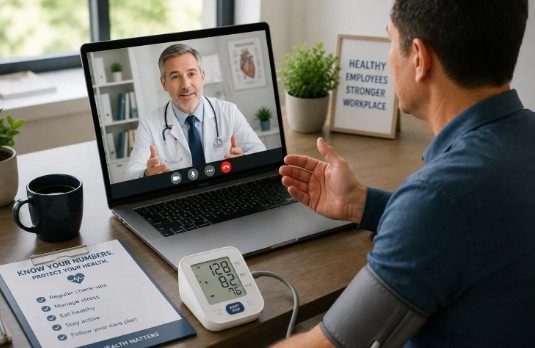

The working day is where many blood pressure stories are actually written, yet it is the part of the day least often measured. Readings taken at home bookend the experience — one before leaving, one after returning — while the eight or nine hours in between, with their deadlines, meetings and hurried lunches, go unrecorded. For anyone trying to understand their numbers, that middle stretch is often the missing chapter.
The Desk Worker’s Blind Spot
Sedentary work disguises its toll well. An hour at a desk feels neutral, even restful, while the cardiovascular system experiences prolonged stillness punctuated by psychological stress — the least favourable combination. Studies of working-age adults consistently find that job strain tracks with elevated daytime readings, and the effect hides precisely because the worker feels ‘just busy’ rather than unwell.
The blind spot matters because daytime patterns guide treatment decisions. A person whose home readings look acceptable may carry markedly higher pressure through the working hours. Without measurement in situ, neither the individual nor their clinician can see the difference, and the truest picture of cardiovascular load stays invisible.
Meetings, Deadlines and Hidden Spikes
Acute stress raises blood pressure within moments — a difficult conversation, a presentation, an inbox that refuses to empty. Most of these spikes are transient and harmless, but their frequency and recovery time tell a story. This is where wearing a blood pressure smartwatch through the working day changes the quality of self-knowledge: a discreet wrist reading after a tense meeting takes seconds, needs no preparation, and captures physiology while it is still talking.
The point is not to police every fluctuation. It is to learn which situations reliably push the numbers, and how quickly they settle afterwards. A spike that resolves in minutes is a normal stress response; one that lingers through the afternoon is information worth having — and worth mentioning at the next health review.
Movement Snacks Between Tasks
The research on breaking up sitting is reassuringly generous: benefits appear from interruptions as short as two or three minutes. A walk to a further printer, stairs instead of the lift, a standing call — each is trivial alone and meaningful in aggregate. Devices that nudge their wearer after long stillness convert good intentions into timed prompts, which is usually all a busy afternoon allows.
Some wearables go further with guided micro-sessions — brief, structured movement designed for office constraints. The value is not fitness heroics; it is circulation being used regularly through the hours when it otherwise would not be. Over a working year, these interruptions accumulate into a genuinely different daily pattern.
Caffeine, Lunch and the Afternoon Dip
The working day comes with its own chemistry. Morning coffee lifts pressure for an hour or two; a heavy lunch redirects blood toward digestion and brings the familiar post-meal slump; afternoon caffeine repeats the cycle. None of this is inherently problematic, but it means that a single midday reading is mostly a picture of lunch, not of health.
Context turns noise into signal. Noting that the 2 p.m. reading always follows the large meal — or scheduling measurements before coffee rather than after — makes the daytime trend interpretable. Wearers who annotate a little learn quickly which wiggles are dietary and which deserve attention.
Leaving Work at Work
The commute home is a physiological transition as much as a geographical one. Pressure that stays elevated into the evening often reflects a day that never properly ended — emails continued through dinner, tension carried to the sofa. An evening reading, taken at the same time daily, measures how well the workday actually closed.
Small closing rituals help the numbers as much as the mind: a short walk after logging off, ten minutes without screens before dinner, a fixed point past which work messages wait until morning. The wrist data makes the benefit visible — evenings that follow deliberate decompression simply read calmer.
What the First Month Usually Reveals
Most people who start measuring through the working day report the same three discoveries within weeks. First, their commute reads in the numbers — rushed journeys leave a mark that calm ones do not. Second, meeting-heavy afternoons behave differently from quiet ones, even when the workload is identical. Third, recovery between stressors matters more than the stressors themselves: two difficult meetings spaced by a walk read kinder than two back to back.
These discoveries are immediately usable. Meeting schedules gain buffers, lunch walks get defended in the calendar, the second coffee moves earlier or disappears. None of the changes require new information — only the visibility that measurement supplies. The first month of data usually pays for the habit outright.
The Payoff of a Measured Workday
A month of daytime-aware monitoring usually changes at least one working habit, and often several: meetings walked instead of sat, coffee timed more kindly, evenings actually ending. The worker gains evidence; the clinician gains a fuller picture; the treatment conversation improves for both. For the millions whose blood pressure risk accumulates between nine and five, a capable blood pressure smartwatch offers something the annual check-up cannot — a record of the hours where the risk is actually being earned, written in the body’s own numbers.